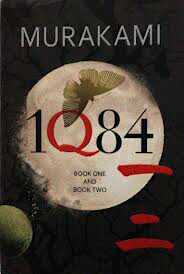
1Q84: books one and two – Haruki Murakami

1Q84

Aomame is stuck in Tokyo traffic on the Metropolitan Expressway, on her way to a meeting she cannot miss. When she leaves the taxi to climb down a partially-blocked emergency exit, Janacek’s Sinfonietta is playing (it is to be a recurrent theme), and the taxi driver tells her, “remember: things are not what they seem…but don’t let appearances fool you. There’s always only one reality.”

Leaving the expressway, Aomame sees a policeman in new uniform, with a new gun, and is informed that the changes occurred after a violent gun battle in the mountains, two years previously. And then she notices that there are two moons in the sky. Aomame is no longer living in 1984, but in the alternate year of 19Q4, where both history and the rules have changed – possibly enough to threaten her life.


Tengo is a part-time tutor in maths at a Tokyo cram school. He writes short stories, meets his married lover once a week, and has no friends. His editor, Komatsu, convinces him to take part in an audacious deception: rewrite a potentially brilliant short story by 17 year old Fuka-Eri, and enter it in a prestigious literary competition, where it is guaranteed to become first famous, and then a bestseller.


From here, events slowly spiral out of control. It becomes apparent that Fuka-Eri did not write the novel herself – she is dyslexic – and she did not submit it to the competition. She escaped from the Takashima commune seven years previously, and has not heard from her parents since.

As curiosity mounts about the best-selling novel’s reticent young author, Aomame accepts a task. She must deliver retribution to a man who has been abusing small children in the name of enlightenment. The Leader of a militaristic commune, deep in the mountains, similar to the subject of a short story recently published about mystical beings known as the Little People…


The tale of 1Q84 unwinds languorously, referencing its namesake, Orwell’s 1984, in the interpretation of thought crimes, and the use of controlling, omniscient authorities in a society for whom the notion of a Big Brother has become blasé and disinteresting. Musical and cultural references link the two separate characters, drawing together a story which might otherwise become dislocated.


Characters are interesting, and the reader is drip-fed facts as they become relevant; there is no overwhelming deluge of exposition here. You will crave it, for the entire story, but Murakami dispenses it carefully, keeping you thirsty until the very end.


Having read it, I am very keen to move onto Murakami’s unexpected sequel, 1Q84: book three. My only objection to 1Q84 is that I think it moves past the institutionalised abuse of the children within the cult a little too quickly, but that in itself works well as the lens of narrative shifts focus.


K.L gives 1Q84 4 out of 5 oddly recurrent themes.


SPOILER ALERT! DANGEROUS WORDS AHEAD!


I don’t know. You’ll finish it, and you won’t know, either. It’s why I have to read the third book… Murakami’s mind control is working well.
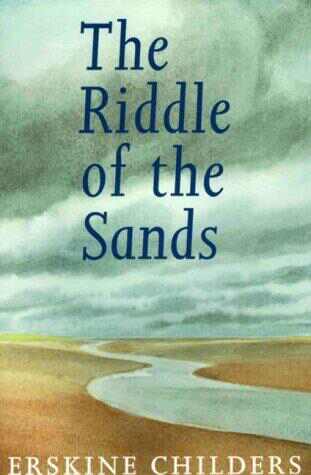
The Riddle of the Sands – Erskine Childer

riddleofthesands

An excercise in patience; The Riddle of the Sands is set to a pace completely unlike that of most contemporary novels; and for a work of spy-thriller fiction, it focusses heavily upon the owrkaday activities of the two central characters, the almost-innocent, enthusiastic sailor Davies; and the book’s narrator, the urbane Carruthers, a minor official of the British Foreign Office, who condescends to join his old school friend on a sailing holiday, and gets rather more (and less) than he bargained for.


Being published in 1903, Childers’ work is a very interesting sketch of relations (and suspicions) between the Imperialist Britain and Germany; in their discussions on the prospect of war, Davies lays out the contemporary view of a man looking across the Channel at a burgeoning empire with fledgling naval capabilities, which is “a new thing with them, but it’s going strong and that Emperor of theirs is running it for all it’s worth. He’s a splendid chap, and anyone can see he’s right. They’ve got no colonies to speak of, and must have them, like us…The command of the sea is the thing nowadays, isn’t it?” The book is also credited with being part of the reason why the British Empire began to improve upon their naval defences pre-World War One. That fun fact is from Wiki, however, so take it with a pinch of sea salt.


The exhaustive detailing of their ‘holiday’ aboard the Dulcibella helped to establish the plausibility of the novel, and set the standard for many authors to follow in the spy thriller genre. The historical value of the novel for this reason, and its fantastic level of detail as regards the voyage along the Frisian coasts up towards the Baltic, make it worth reading. However, it fails to carry the reader forward at any significant pace; your own efforts to finish it will be the only means of propulsion.


The characters were genuine enough, though Carruthers’ cosmopolitan brattishness can wear thin. The eventual realization that the secret German military plans are directed at offence, not defence, fail to titillate a post-Wars reader, when the speculative fiction has long since become similar to historical fact. The ‘grand denouement’ is more than a few decades late in providing a thrill; my response upon learning the twist was more of a, “Well duh, Childers,” than a “By Jiminy!”


I would suggest that The Riddle of the Sands has greater value as a dry accoutn of small-yachting in the Baltic coastal region than it does as a spy thriller.


K.L gives The Riddle of the Sands 2 out of 5 handfuls of Frisian mud.

Etiquette & Espionage – Gail Carriger

Etiquette and Espionage

A delightful lark. Fourteen-year-old Sophronia Angelina Temminnick has driven her mother to the end of her manicured wits.

After an unfortunate incident involveing a sabotaged dumbwaiter, a plate of trifle, Mrs. Barnaclegoose’s head, and of course, Sophronia as Exibit A, The Condemned, she is packed off to Mademoiselle Geraldine’s Finishing Academy for Young Ladies of Quality.

It is not the fate worse than death that Sophronia expects. Firstly, the Academy is a vast dirigible which floats its way across the moors of Dartmouth, rather than being sensibly anchored to the ground, and secondly, its students learn not merely the arts of flirtation, dance and household management, but also espionage and assassination. Their shadowy agents have been watching Sophronia for some time, and her predilection for investigation and chaos have resulted in her becoming covertly recruited to join the academy.

The normal pace of lessons aboard the flying academy is somewhat unhinged when Sophronia arrives, accompanied by resident mean-girl, the beautiful Monique de Pelouse. Partnering up with Dimity, who brother Pillover is in training to become an evil genius, Sophronia must discover what Monique is hiding from the Academy, before her actions ensure its destruction by dastardly Picklemen, who will stop at nothing to obtain The Prototype.

Set in a Steampunk 1800’s England, Etiquette & Espionage is fun, well-paced, with interesting and lively characters. The references to ladylike behaviour and dress seem to be refreshingly tongue-in-cheek, and Sophronia’s chracter is intelligent, curious, and shows no qualms about breaking stuffy rules to achieve her goals.

I look forward to reading the sequel when it comes out.

K.L gives Etiquette & Espionage 3.5 out of 5 werewolves in top-hats.

Scary Mary – S.A. Hunter

ScaryMary

A pedestrian novel: Outcaste high school girl meets highly desirable new kid. They fall in love. Her mysterious secret threatens to destroy them, until she faces catharsis by first confessing her dark secret (mandatory rejection at this point), then proving that things really do go bump in the night, and finally by saving everyone’s lives, vindicating herself and rekindling the romance.

If that is a mouthful, then let me summarise even more briefly by comparing it to Stephen King’s novel Carrie, but replacing mind-bending powers with mere clairaudience, and bullying ostracism with…well, more bullying and ostracism. Unlike Carrie, Mary rallies a sense of self-preservation and is the of-course-pretty Goth girl that everyone at school loves to hate.

Once more, pedestrian. I need to stop reading literary fast-food; it causes nothing but indigestion. No more slumming it in the $0.00-.99 range of ebooks, K.L.

For once, I would like to read a story about an outcaste school girl (or boy) who is:

a. Genuinely ugly

b. Has really bad acne from all the white face paint she cakes on, and,

c. Is not the target of unrealistic levels of bullying.

I’m not saying that such things don’t happen – but let’s try and find a protagonist who doesn’t force us to like them by virtue of being at the bottom of the schoolyard pecking order. It’s a boring, over-utilised trope that is indicative of a lazy imagination. An ultimately uninspiring read.

(To segue back to Carrie; that book is a brilliant depiction of a character who you start out repulsed by. King doesn’t want you to like her, and you don’t. Not until she starts learning to respect and assert herself, and in the end, you wish for her to get a little slice of happiness. The chance of which is masterfully ripped apart by the forces of her own mind, fractured by one practical joke too many.)

K.L gives Scary Mary 1 out of 5 well-used black makeup pencils.

A Job from Hell

A job from hell

A Job From Hell – Jayde Scott


This book is so awful (well, it is free) that I deleted it from my reader halfway through, then went back, re-downloaded and skim-read it just so that I could be scathing about it later, and warn you, dear reader.


That might sound cruel, but I have a number of objective criticisms of the story.


A self-described fat girl “with chubby arms and stumpy legs,” Amber takes on a job as housekeeper in a remote mansion in Scotland, to earn money for college the following year. She has been dumped by her boyfriend, Cameron, for putting on a few pounds, and is still mooning over him, determined that he simply needs a break, that their relationship will rekindle, and he will finally introduce her to his parents.

Having established her unflattering physical characteristics early on, the author then proceeds to tell the readers at every opportunity about her attractiveness, an irksome and repetitive inconsistency. “The blue skinny jeans looked really good on me, making my legs seem so much longer,”…. “After slipping into a black, long-sleeved top that emphasized my narrow waist and a pair of blue skinny jeans…”


The protagonist, Aidan, Amber’s erstwhile employer, is a sizzlingly hot half-millenia-old vampire, who refuses to drink human blood, or harm humans, whilst fighting his battles against the forces of darkness. Anne Rice’s Lestat was the first “vegetarian” vampire, and possibly should have stayed the only one; if not, then the Cullens should have been the last such group featured. It is unoriginal these days, to a stunning degree, made more so by Aidan’s special ability; he can control peoples’ thoughts, but has difficulty influencing or hearing Amber’s own; the most he can do is send her to sleep. Someone tell Stephanie Meyer that Edward has been wandering across novels…

That aside, he is the stereotypical romantic protagonist: filthily rich, good-looking, domineering, perpetually eighteen and emotionally scarred; Aidan has not been romantically involved since his last love interest betrayed him. This gives Amber a number of incentives to “win” him, and the act of breaking down his emotional shields immediately qualifies her to be the recipient of his affluence. Aidan is aware when they first meet that he and Amber are destined to be soul-mates, a fact which somehow vindicates his forcing her to fall asleep after a night out with him by using his vampire mental-judo, and then kissing her while she is unconscious, unable to provide or withhold consent.

That is known by adults as “date rape,” but she is ok with it (and so, apparently, is he); Amber immediately starts puzzling over her feelings for Aidan versus her ex, Cameron. She spends pages of dreary monologue, both internal and external (with her new BFF Cass), consistently failing the Bechdel Test, a pattern which is duplicated in most girl on girl conversations throughout the book.


Amber is consistently demonstrated to be both spineless and stupid. She lets herself be bullied by her brother into robbing a shack in the woods (stealing some magical gemstones which brings her to the attention of the supernatural community), and allows herself to be manhandled and sexually harassed by Kieran, Aidan’s brother without a single vocalised objection.

Her friends and associates in the book consist largely of a troupe of Aidan’s vampire and demonic buddies, who are quite happy to imprison her inside the house with no means of external contact, for her own safety. This illegal imprisonment at the hands of Kieran is described, “Why couldn’t Cameron pay me this much attention? If only he knew, surely he’d come to his senses. He’d know what a huge mistake he made by dumping me and he’d spend the rest of his life making it up to me because we belonged together…”

This is after Kieran physically bars her from leaving the house, stops her from using a phone, threatens to tie her up or handcuff her to the bed, flirts consistently (and unwelcomely), and then starts suggesting a sexual romp, stroking her cheek and telling her that his brother, Aidan, the love interest, doesn’t need to know. And Kieran is a Good Guy.

Her objections to curtailment of personal liberties are weak, as though she is a puppet whose existence is defined by those who control her; the possibility of leaving the Stockholmian manse and fleeing back to reality in London is considered objectionable.

Adrian’s (an occasional first-person narrator; how else would we get our exposition?) inner dialogue confirms this. Amber is his possession – “she was mine”, “my mate” etc; and as a result, imprisoning her and sexually touching her against her will is ok, because she’s bound to get over it one day.


If I met Amber in reality, the main descriptive term used would be “dangerously obsessive bunny boiler.” After her second kiss (because being kissed while semiconscious by an employer is what most people consider a positive), Amber reflects, “I had let him kiss me again. Seduced by the rich kid, only to be pushed away when he had enough of me. Apparently taking care of business in the middle of the night was more important than finding out whether the attraction between us was real.”


My objections could go on for pages. There were no redeeming qualities to this book.


K.L gives A Job from Hell 0 out of 5 juvenile wish-fulfilment fantasies.


SPOILER ALERT! DANGEROUS WORDS AHEAD!


Of course she gets turned into a vampire, in a blame-absolving, “It was that or you’d die!” turn of events. And some conveniently-timed magical spell allows them to walk in daylight and not require blood to survive.

Now all they need to do is sparkle.


The Killer Wore Leather – Laura Antoniou

killerworeleather

New York is hosting its annual Mr. and Ms. Global Leather (and Bootblack) competition. Kinksters from all American states have streamed in for a three day weekend of workshops, competitions and play. The previous winners, Mack Steel and Mistress Ravenfyre, gather with the panel of judges to begin the three-day-long weekend of kink. All of them loathe each other, from the Neanderthalic adherents to a Gorean—sorry, Zodian fantasy universe, to the elderly lesbian professor of sociology (with honours in acidic social commentary). All in all, a normal Mr. And Ms. Global Leather, et al, competition.

And then the penultimate bad boy of leather, Mack Steel, is discovered dead in his hotel room. Wearing nothing but a pair of frilly yellow panties.

How do you find a killer, when everyone who knew the man hated him? How do you even select your suspects?


Enter single, lesbian, Detective Rebecca Feldblum, assigned to case by a boss that tells her, ‘They’re your people, right?’, and also assigned an ultra-conservative partner from the deep South…

Nothing could make things worse. Except perhaps that all the suspects will be leaving in three days, and discovering that her very-ex-girlfriend is also attending Mr. And Ms. Global Leather…


Amusing. A tongue in cheek, merry observation of the politics and personalities of small societies wrapped up in an interesting and well-paced whodunnit. The setting of a kinky social gathering is clever and novel. Crossing my fingers for a sequel, this is a light read, with an interesting subject matter.


K.L gives The Killer Wore Leather 4 out of 5 spanks with a Zodian slave goad.


SPOILER ALERT! DANGEROUS WORDS AHEAD!


Sadly, the eventual killer was a little easy to pick. But I’m just cynical like that.


2001: A Space Odyssey – Arthur C. Clarke

2001: A Space Odyssey

I have never seen 2001: A Space Odyssey. So when my favourite pop culture website (http://www.cracked.com/article_19138_7-hotly-debated-movie-questions-that-totally-have-answers_p2.html)mentioned the movie in one of their articles, I decided to take the book for a spin.


The first thing one should know, is that the book 2001: A Space Odyssey, was written and published in 1969, subsequent to the movie, which was released in 1968. In past experience, this is nearly always a warning sign as to the quality of the novel (the novel Gladiator, for instance, was simply the movie with a few deleted scenes added in, and some fairly pedestrian descriptions tacked on. Ditto for The Ghost and The Darkness).

Unfortunately, 2001: A Space Odyssey was no exception to the rule (if you can recommend any books which are, please let me know). I am still keen to see the movie, because I think that some of the pacing and events were probably framed with the visual medium in mind, but I cannot recommend the book at all. Which makes me feel a little bad, seeing as it was written by Arthur C. Clarke, a renowned Sci-Fi author, amongst other things. The writing felt not only formulaic (possibly due to many post-2001 imitations which I encountered in advance of the original), but also dense, the narrative failing to flow.


One interesting idea expressed was that HAL malfunctioned in the violent way that it did, because its construction and intelligence development had left it unable to practice deception. The burden of knowing the ship’s true mission, and knowing that its human companions were completely ignorant, caused HAL to experience a cascading series of malfunctions in its programming, culminating in its’ attempt to sever all contact with Earth and kill the crew-members.


K.L gives 2001: A Space Odyssey 0 out of 5 homicidal robots unable to deal with deception.

The Witch Sea – Sarah Diemer

The Witch Sea

A lesbian short story, about a young woman tasked by her mother and grandmother with keeping an ancient and malevolant sea god chained on land, to prevent him from destroying humanity.

The sea god keeps sending emissaries to plead for his freedom, sea creatures who have been transformed into humans. Once an animal breaches the barrier between him and the ocean, it is transformed into a human being to keep him company in exile. Each night, they make their way to the edge of the bay, and stare out longingly at the ocean that Meriel and her maternal line have denied them.
Eventually the protagonist, Meriel, falls in love with one of the emissaries, a shapeshifted seal named Nor, and questions her role in imprisoning the god and his minions, who suffer continually because of her actions.

Ultimately, it failed to attract and maintain enthusiasm I felt for the premise. I felt like the backstory could have been fleshed out more fully; that it did not, lost The Witch Sea an opportunity to develop interest and depth. There were large logical holes – if the witches were so powerful as to deny a god his freedom, why were they living in poverty and solitude in a lighthouse on a tiny island? Surely they could think of better things to do? As the only human around, constantly casting magic to keep the god chained, where did Meriel obtain food and necessities?

K.L gives The Witch Sea 1 out of 5 fish trapped in bowls.


SPOILER ALERT! DANGEROUS WORDS AHEAD!

Meriel eventually sets the sea god free, watching her love transform and leave her forever. The lack of structure to the tale makes me wonder: what does she do next? There is no future hinted at here, and no future direction provided without the context of a town full of imprisoned people.

The Storyteller – Jodi Picoult

The Storyteller

Picoult specialises in moral dilemmas, which can at times become irksomely repetitive (every book has another life-challenging question that characters must address and act upon).
The Storyteller, however, tweaked my interest by involving two things:
1. Euthanasia, and
2. Nazi war criminals

Being a fan of books and movies like The Boys from Brazil and Apt Pupil, I jumped wholeheartedly into The Storyteller, and was rewarded with vivid characters well expressed. I enjoyed it, and the realism that throbbed in every word.
One unfortunate occurrence is that Picoult seems to be deviating down the path of many modern Dean Koontz novels, and trying (it seems) a little too hard to create quirky, “fiction stranger than truth” type characters. Each one is just a little too individual, from the ex-nun who has visions of God and has established a spiritual haven for day-trippers, to the barista who speaks only in Haiku, and the Department of Justice representative who only listens to 8-track music, and appears partially stuck in the 1950’s.
The novel progressed with pace, aplomb and riveting interesting maintained by the stories-within-stories which were featured. An enjoyable, easy read.

K.L gives The Storyteller 4 out of 5 war criminal arrest warrants.

SPOILER ALERT! DANGEROUS WORDS AHEAD!

Ultimately however, I had an ethical objection to the main character Sage’s actions. She managed to turn an ethical and legal issue, that of the right to die, into an act of revenge.
I hesitate to say petty revenge, as it was a Nazi war criminal, but—no, it was petty, and personal, which robbed the novel of the entire objective it had been building towards: trying to get Jacob to incriminate himself enough for extradition and trial.